Sunscreen: The Ultimate Guide
At First Derm we care about skin. We work with dermatologists and skin issues all day long. More often than not, the most serious cases are due to skin cancer. A great way to protect yourself is to use sunscreen. However, we appreciate that the world of sunscreen can be a confusing one. With many brands, SPFs and other claims it can be difficult to navigate this complex sun blocking world.
Fear not… We’re here to help you with our comprehensive guide. If you prefer to skip to a section then click the link below!
- Why Use Sunscreen?
- Different Types Of Sunscreen
- What is SPF?
- Best Sunscreen Ingredients
- Eczema and Sunscreen
- How to Apply Sunscreen
- Sunscreen Benefits
- Sunscreen at the Beach Tips
What Is Sunscreen?
First and foremost, let’s understand what it is exactly. Sunscreen is a formulation which helps protect the skin from UV radiation. This UV radiation comes in two forms: UVA and UVB.
- UVA rays have a bigger wavelength, meaning they can penetrate deeper into the skin, resulting in tissue damage – these rays are responsible for premature aging
- UVB rays have a shorter wavelength, they stay superficially on the skin and are responsible for sunburns and or skin cancer.
There are various types of sunscreen as discussed later in this post. All of them work to block or absorb the suns rays so that your skin is not damaged by the sun.
Try our FREE dermatology search engine and get peace of mind within a second.
Why Use Sunscreen?
This one may be fairly obvious to all of us. Without it, we get burned. Most of us know that already but there are many other reasons for using a sun cream or protecting oil.
Regardless of rain or shine, the sun emits rays that can harm the body. When you’re over-exposed to these rays, the damage on the skin and body can be irreversible and even life-threatening.
Over exposure to the sun can cause severe damage to the skin.
- Sunburns speed up the aging process of the skin, creating wrinkles and dark spots.
- Without sunscreen you heighten your risk of skin cancer
Without applying protection, you put yourself at risk of melanoma, basal cell carcinoma and squamous cell carcinoma.
Different Types Of Sunscreen

What Type Is Best?
Now that we know the importance of protection. What are the different types? The two key types to look for are chemical and physical sunscreens.
Chemical
Chemical sunscreens protect your skin by absorbing UV rays, and then converting them into heat within the skin. They are smooth, easy to apply, and don’t leave that pesky white cast on our skin. While they’re essentially invisible and sit well under makeup, chemical protection can clog your pores and cause acne. Also, by heating up the skin, they create ideal conditions for bacteria to grow.
Best for: Those who sweat a lot or for water related activities. These sunscreens are usually water resistant.
Active Ingredients: Avobenzone, Octinoxate, Oxybenzone
Physical
Physical sunscreens do pretty much exactly what they say. They physically block UV rays. It is typically, thick and very white. It may not sit well under makeup, but it does an effective job of protecting the skin. Physical sunscreens usually contain zinc oxide, an ingredient that can decrease redness, soothe the skin, and are ideal for those with sensitive or acne-prone skin.
Best For: Children, those with sensitive skin and Acne
Active Ingredients: Titanium dioxide and zinc oxide
Try our FREE dermatology search engine and get peace of mind within a second.
What is SPF?
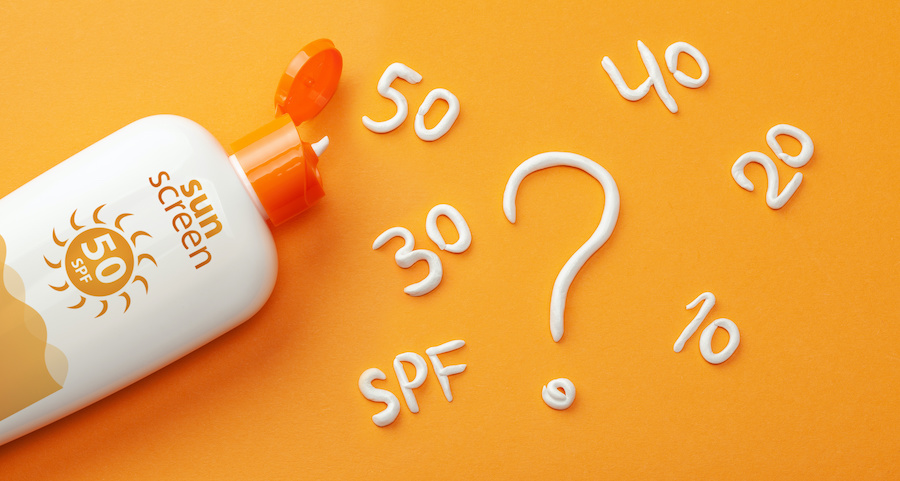
What is SPF?
You will often see a number on the bottle of sunscreen. This is usually the SPF number. What does this mean?
SPF simply means Sun Protection Factor. Its a method of understanding a sunscreen’s ability to prevent UVB (one type of UV radiation) from damaging your skin.
A super simple way to understand it is this: The number on the bottle corresponds to the length of time it will protect your skin. So… If you apply SPF 15, it takes 15 times longer for the sun to damage your skin than with no protection at all.
So Higher SPF is better?
Not necessarily… In fact according to Skin Cancer Foundation, most SPF 15 products are sufficient in protecting your skin against UVB.
SPF 15 sunscreen blocks 93% of UVB Radiation. SPF30 blocks almost 97%.
According to the testing process and studies made, protection is minimal after SPF 50. In fact the testing process uses much more sunscreen than we normally put on our skin. This means we actually only get around 1/3 of the labeled value when applying. It’s also worth remembering that while products with high SPF prevent sunburn (mainly caused by UVB), it doesn’t protect you from UVA. UVA accelerates skin aging, damages your skin and can contribute to skin cancer.
Try our FREE dermatology search engine and get peace of mind within a second.
Can You Trust Your Sunscreen?
Consumer reports tested 104 products over 4 years and found only 52% meet their claims. Please be sure to check before you buy!
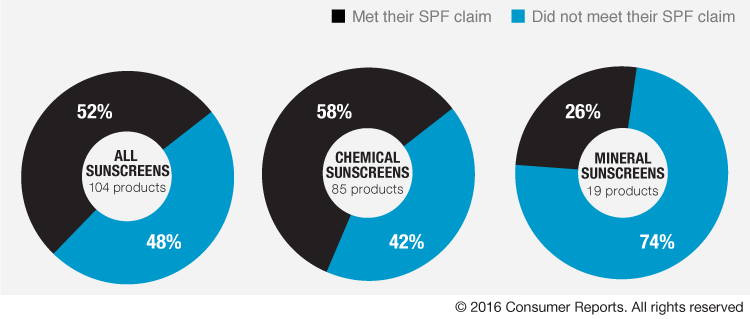
Can you trust the SPF?
<
Best Sunscreen Ingredients
In the United States, sunscreens are regulated as a drug because it makes a drug claim. That is: to help prevent sunburn or to decrease the risks of skin cancer and early skin aging caused by the sun.
In the EU or other parts of the world, they are regulated as cosmetics due to a difference in the composition requirements.
It is worth noting that in the US, sunscreens are strictly subject to FDA approval before being commercialized. This means active ingredients in your sunscreen have been tested in clinical trials before they were declared safe to use.
First and foremost there are some clear things to look for:
- Broad spectrum-protects from both UVA and UVB rays
- Fragrance-free-lower risk of allergy and irritation
- Non Comedogenic – will not clog your pores
- SPF30 or higher
What Are the FDA approved ingredients?
- Aminobenzoic acid
- Avobenzone
- Cinoxate
- Dioxybenzone
- Homosalate
- Meradimate
- Octocrylene
- Octinoxate
- Octisalate
- Oxybenzone
- Padimate O
- Ensulizole
- Sulisobenzone
- Titanium dioxide
- Trolamine salicylate
- Zinc oxide
Try our FREE dermatology search engine and get peace of mind within a second.
Ingredients to Avoid
Oxybenzone
Although FDA approved, oxybenzone or Benzene-3 can be highly irritating to the skin and when applied. It can be absorbed into the bloodstream, upsetting the body’s natural hormone levels.
Retinyl Palmitate
Retinyl Palmiate breaks down when exposed to sunlight. It can damage skin cells, DNA cells and eve create skin tumors.
Fragrance or Alcohol
Fragrances and alcohol can irritate and dry out the skin. Fortunately, most physical sunscreens do not use either of these ingredients in their formulas.
If you suffer from eczema, the thought of adding random oils and ingredients to your skin might make you itch all over. Chemicals, preservatives and the base used can all play their part in irritating your skin. Fortunately the national eczema association has helpfully created a seal of acceptance program. This highlights products that are safe for eczema sufferers. Their criteria is as follows:
- Mineral Based Ingredients Such as Titanium Dioxide and Zinc Oxide
- Alcohol Free
- SPF 30 or greater
- Broad Spectrum protection from both ultraviolet (UVA) and UVA B rays
The best sunscreen for eczema is much the same as our general recommendations. However, physical blockers do tend to be best. Since your skin is sensitive, we recommend that you apply a pea sized amount on your wrist or elbow. Leave it for 24-48 hours and watch for any allergic reactions, rashes or redness.
Try our FREE dermatology search engine and get peace of mind within a second.
How to Apply
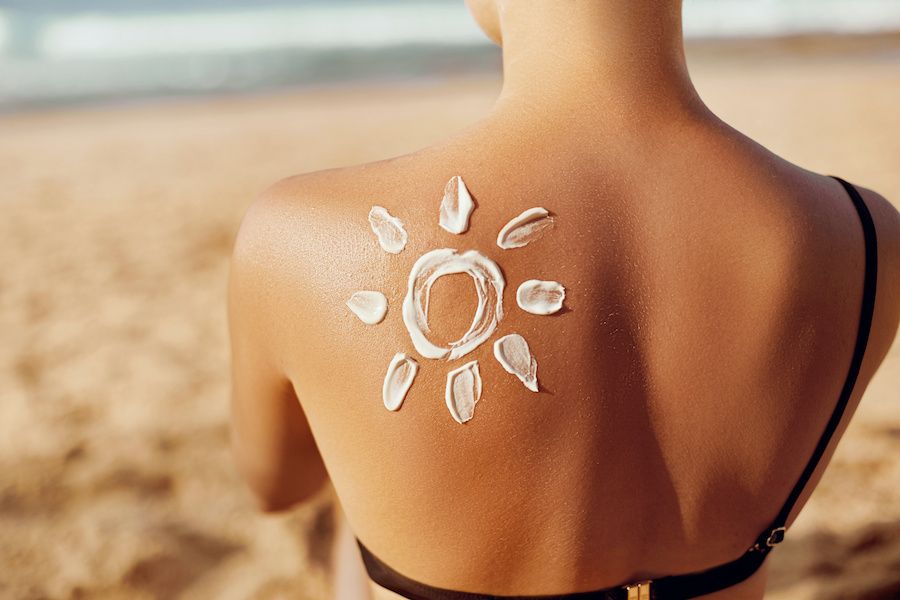
Sun protection and how to apply.
Hopefully now we have a good idea on what sunscreen is best for us. Next… How to actually apply sunscreen and how often?
We recommend you apply sunscreen on a daily basis, not just if you going to the pool or beach. The Skin Cancer Foundation recommends applying your whole body with one full ounce (or one shot glass) of sunscreen 30 min prior to sun exposure and reapplying every 2 hours.
There’s no rocket science to applying sunscreen. Lather your body up and try to do it in 2 hour intervals. If you’re in the sea or pool and your sunscreen isn’t waterproof, reapply after getting dry.
Regular daily use of SPF 15 sunscreen can reduce your risk of developing squamous cell carcinoma (SCC) by about 40 percent and lower your melanoma risk by 50 percent.
A quick step-by-step:
- Apply evenly to all uncovered skin, especially your lips, nose, ears, neck, hands, and feet.
- Apply 15 minutes before going out in the sun.
- If you don’t have much hair, apply to the top of your head, or wear a hat.
- Reapply at least every two hours or immediately after swimming.
- Give babies and children extra care in the sun. Ask your health care professional before applying to children under 6 months old.
- Never apply to damaged or broken skin.
Try our FREE dermatology search engine and get peace of mind within a second.
Added Sunscreen benefits
Do you know? Applying sunscreen every day has other benefits, too. First of all, sunscreen can help prevent acne by regulating the skin’s sebum production. This production is often disrupted by UV rays. This means you’ll get fewer pimples.
Secondly, when using active ingredients, like AHAs, BHAs, and retinoids, to treat acne, the skin is more photosensitive. To protect the skin during its healing process, applying and reapplying sunscreen is a must.
Quick Tips While At The Beach

Tips For Sun Protection at the Beach
- Both water and sand reflect sunlight
- Fair-skinned people absorb more solar energy
- Reapply sunscreen frequently, especially after activities near water or heavy sweating
- Avoid exposure to the sun between 10 a.m. and 4 p.m.
- Keep infants under 6 months out of the sun
Don’t Leave it Late
If you notice a mole has changed, a spot has appeared or even a lump, speak to a dermatologist. They can check for skin cancer – a disease that you must check early. You have a 95% chance of survival if detected early. If not, you could lose your life. Speak to a dermatologist such as ours today.
Try our FREE dermatology search engine and get peace of mind within a second.
Ask a Dermatologist
Anonymous, fast and secure!
Over 15,000+ Readers
Get fresh content from First Derm


Ask a Dermatologist Now
Anonymous, fast and secure!

The Specialist doctor from the University Hospital in Gothenburg, alumnus UC Berkeley. My doctoral dissertation is about Digital Health and I have published 5 scientific articles in teledermatology and artificial intelligence and others.