Ultimate Guide: Tattoos and your Skin
- Check first. Talk to a doctor or dermatologist before booking if you have an immune condition, uncontrolled diabetes, keloid-prone skin, psoriasis, or eczema, or if you are pregnant or breastfeeding.
- Choose carefully. Pick a licensed studio, ask about its inks and sterilization, and avoid “temporary” black henna.
- Heal gently. Wash with soap and water, use a mild fragrance-free moisturizer, and do not pick scabs or soak the tattoo.
- Know the warning signs. Spreading redness, worsening pain, pus, open sores, fever, or chills need prompt medical care. A new itch, bump, or rash in a tattoo is worth having checked.
- Look after it long term. Protect the tattoo from the sun, keep checking your skin, and tell the radiology team about your tattoo before an MRI.
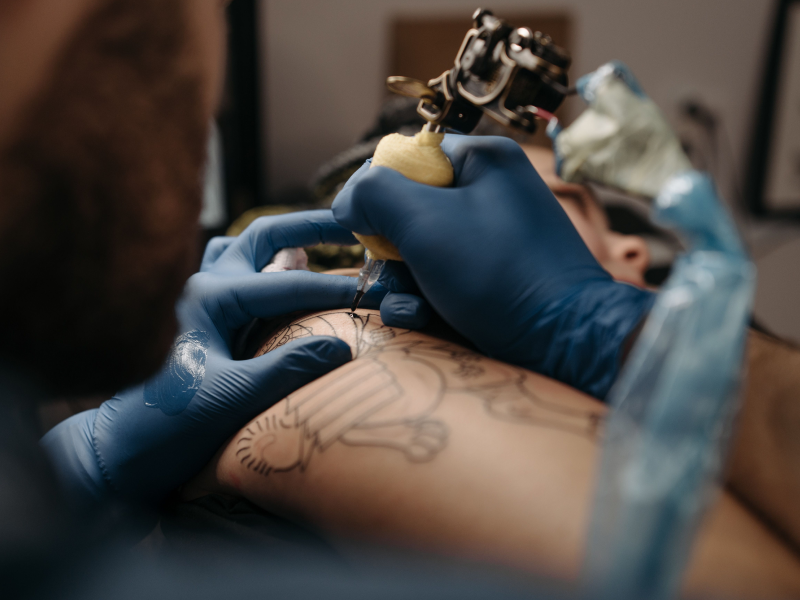
Tattoos have gone mainstream. But unlike most fashion choices, tattooing has the potential to affect the long-term health of your skin. So before you decide to get your new partner’s name scrawled across your back (“I swear, mom, they’re the one!”), it is worth understanding the preparation, the care, and the evidence that has emerged over the last decade.
Is a tattoo safe for you?
This list is easy to skip, because you’re focused on the design, not on whether your skin is ready for it. A few groups should pause and talk to a doctor or dermatologist first:
- People with immune conditions or on immunosuppressive medication. Immunosuppressive drugs can, in theory, raise the risk of infection, so a sterile procedure matters even more.
- Uncontrolled diabetes. Poorly controlled blood sugar can raise the risk of infection, so talk to your doctor first.
- Keloid formers. If you scar badly from minor injuries, tattooing can trigger keloids.
- Psoriasis or atopic dermatitis (eczema). Tattooing may cause these conditions to flare.[1]
- Pregnancy and breastfeeding. The toxicological risks of tattoo ink ingredients are still not well understood,[2] and infection during healing is a risk, so talk to your doctor before booking.
- Darker skin types (Fitzpatrick IV to VI). Healing inflammation can leave post-inflammatory hyperpigmentation, which is more common and more severe in darker skin. Laser removal can also change skin color, so look for a clinician with experience treating your skin type.
If any of these apply to you, a quick consultation before booking can save a lot of trouble.
Choosing a studio and inks
Ink safety depends on the artist’s technique and also on how well the inks themselves are made and regulated.
Regulations: US and EU
In the United States, the FDA classifies tattoo inks as cosmetics, which do not require pre-market approval.[3] In 2024, the FDA issued final guidance recommending that manufacturers test inks for contamination and prevent it during manufacturing.
In the European Union, the REACH regulation has restricted hazardous substances in tattoo and permanent makeup inks since January 2022, including chemicals that cause cancer or genetic mutations, are toxic to reproduction, or act as skin sensitizers or irritants.
Rules do not guarantee a clean bottle, though. In a study by FDA scientists, 26 of 75 tattoo and permanent makeup inks (about a third) contained bacteria, including inks in sealed bottles, and a sterility claim on the label did not predict a clean ink.[4] This is exactly why doing your homework still matters.
Questions to ask the studio
- Are the inks labeled, with ingredient lists, and REACH compliant (EU)?
- Are inks from sealed, single-use containers, never topped up or diluted with non-sterile water?
- Do artists wash hands and change gloves between every step?
- Is all reusable equipment autoclaved, with spore test records available?
- Is the studio licensed by your local or state authority?
Unsanitary conditions are still an immediate deal-breaker, just as they were in 2015. But ink sterility at the manufacturing level deserves attention too, not only the artist’s technique.
Avoid black henna
“Temporary” black henna tattoos, popular at holiday destinations and festivals, are made by adding para-phenylenediamine (PPD), a hair-dye ingredient, to henna. PPD can cause dangerous skin reactions in some people, and once you are sensitized, you may react to hair dyes that contain it. Avoid them.
Aftercare, phase by phase
Gentle wound care is the aim. Aftercare advice is not standardized: a review of 700 US aftercare instructions found that they varied tremendously, and 14.9% encouraged topical antibiotics.[5] Check with a dermatologist before using antibiotic ointment on a new tattoo.
Days 0 to 2
Follow your artist’s instructions on how long to keep the tattoo covered. When the dressing comes off, wash the tattoo gently with soap and water and pat it dry.
Days 2 to 14
Wash the tattoo twice a day with soap and water and a gentle touch, then apply a mild, fragrance-free moisturizer. Do not soak the tattoo: stay out of bathtubs, hot tubs, pools, rivers, lakes, and other bodies of water until it has healed, and keep direct streams of shower water off it. Leave scabs alone. They fall off on their own, and picking at them can irritate the skin or cause infection. If your studio’s aftercare sheet tells you to do something different from these steps, check with a dermatologist.
Long-term care
Once healed, moisturize normally and protect the tattoo from the sun, because UV light can fade some tattoo inks. Researchers have also raised concerns about phototoxicity and about ink ingredients being converted into toxic substances, although little is known about the toxicological risks so far.[2] Sunscreen is no longer just about keeping the design pretty.
Long-term health considerations
Many people wonder about cancer risk and MRI safety, and the evidence is still evolving.
Cancer risk. A 2016 review found no well-defined association between tattoos and cancer.[1] Newer studies have raised questions. A 2024 Swedish case-control study found that tattooed people had a 21% higher adjusted risk of malignant lymphoma, although the result was borderline and chance cannot be ruled out.[6] A 2025 Danish twin study reported a higher risk of lymphoma and skin cancer among people with tattoos larger than the palm of a hand,[7] although the Swedish study found no rise in risk with tattooed area.[6] Both newer studies show associations, not proof of cause. In short, the evidence is suggestive, not conclusive, and more research is ongoing. In practice, the advice is simple: know your skin, and do not let tattoos obscure moles during self-exams.
MRI safety. If you have a tattoo, you can still have an MRI, and reactions are uncommon.[8] In reported cases, people felt a sudden burning in the tattooed skin during the scan, and it cleared quickly with no lasting harm.[8] Tell the radiology team about your tattoo beforehand, and let them know right away if you feel warmth or burning during the scan.
Aging. Over the decades, tattoos fade and fine lines can blur. Protecting the tattoo from UV light helps limit fading.
Removal and modification
Regret is not unusual, and it isn’t a verdict on your judgment at the time.
Laser removal. Lasers are the standard way to remove a tattoo. Picosecond lasers may clear blue, green, and yellow inks better than conventional Q-switched lasers, although the studies vary and larger trials are still needed.[9] Plan for several sessions. Scarring or a change in skin color can happen, and complete removal is not always possible. Removal is considered a cosmetic procedure, so medical insurance generally does not cover it.
When removal is risky. Some health and skin conditions can make laser removal riskier, including certain autoimmune disorders, pigmentation problems, and active skin conditions. See a dermatologist or dermatologic surgeon before you start, especially if your tattoo has ever caused an allergic reaction.
Home removal creams and kits. Still avoid them. Some at-home removal kits contain acid, which can cause permanent skin injury.
Cover-ups. A skilled artist can often transform rather than erase. Some people lighten the old tattoo with a few laser sessions first, which can give the new design more room to work with.
Quick reference: what to check by region
A legal comparison doesn’t help much if you’re just trying to get inked safely, so here’s what the regulations above actually mean for you.
| United States | European Union | |
|---|---|---|
| The short version | Inks are regulated as cosmetics, and in 2024 the FDA issued guidance recommending that makers test inks for contamination | REACH has restricted hazardous substances in tattoo ink since January 2022 |
| Ask the studio | Is the ink from a sealed, single-use container, with sterilization records on hand? | Is the ink labeled REACH-compliant, and can they show documentation, not just a claim? |
| Still worth knowing | In a study by FDA scientists, 26 of 75 inks contained bacteria, and a sterility claim on the label did not predict a clean ink[4] | A label alone is not proof, so ask to see the documentation |
The bottom line
Getting a tattoo was never risk-free, and the research landscape has only gotten richer since 2015. Pick a licensed studio with labeled, compliant inks, follow phased aftercare, watch for the warning signs above, and keep your skin checked. Do all that, and you are far more likely to end up with a work of art that looks great for the rest of your life rather than an expensive, painful mess.
References
First Derm ensures the highest quality and accuracy in our articles by using reliable sources. We draw from peer-reviewed studies, academic research institutions, and reputable medical journals. We strictly avoid tertiary references, linking to primary sources such as scientific studies and statistics. All sources are listed in the resources section at the bottom of our articles, providing transparency and credibility to our content.
- Islam PS, Chang C, Selmi C, et al. Medical complications of tattoos: a comprehensive review. Clin Rev Allergy Immunol. 2016;50(2):273-286. doi:10.1007/s12016-016-8532-0
- Laux P, Tralau T, Tentschert J, et al. A medical-toxicological view of tattooing. Lancet. 2016;387(10016):395-402. doi:10.1016/S0140-6736(15)60215-X
- Daddy-Gaoh S, Foley SL, Kweon O, Kim SJ. Nontuberculous mycobacteria skin infections associated with tattoos. Front Public Health. 2026;14:1854792. doi:10.3389/fpubh.2026.1854792
- Yoon S, Kondakala S, Foley SL, et al. Detection of anaerobic and aerobic bacteria from commercial tattoo and permanent makeup inks. Appl Environ Microbiol. 2024;90(7):e0027624. doi:10.1128/aem.00276-24
- Liszewski W, Newcomer J, Laumann AE, Leger MC, Farah RS. An analysis of the content and recommendations of 700 American tattoo aftercare instructions. Dermatology. 2023;239(6):988-995. doi:10.1159/000533489
- Nielsen C, Jerkeman M, Jöud AS. Tattoos as a risk factor for malignant lymphoma: a population-based case-control study. EClinicalMedicine. 2024;72:102649. doi:10.1016/j.eclinm.2024.102649
- Clemmensen SB, Mengel-From J, Kaprio J, Frederiksen H, von Bornemann Hjelmborg J. Tattoo ink exposure is associated with lymphoma and skin cancers: a Danish study of twins. BMC Public Health. 2025;25(1):170. doi:10.1186/s12889-025-21413-3
- Alsing KK, Johannesen HH, Hansen RH, Serup J. Tattoo complications and magnetic resonance imaging: a comprehensive review of the literature. Acta Radiol. 2020;61(12):1695-1700. doi:10.1177/0284185120910427
- Gurnani P, Williams N, Al-Hetheli G, et al. Comparing the efficacy and safety of laser treatments in tattoo removal: a systematic review. J Am Acad Dermatol. 2022;87(1):103-109. doi:10.1016/j.jaad.2020.07.117
Ask a Dermatologist
Anonymous, fast and secure!
Ask a Dermatologist Now
Anonymous, fast and secure!

The Specialist doctor from the University Hospital in Gothenburg, alumnus UC Berkeley. My doctoral dissertation is about Digital Health and I have published 5 scientific articles in teledermatology and artificial intelligence and others.